In your list of AncestryDNA® matches, we show those with the closest predicted relationships first and the most distant last. This order is also the amount of DNA you share from highest to lowest
To learn more about how you and a DNA match may be related, see How We Measure Relationships between AncestryDNA® Matches.
Degrees of separation
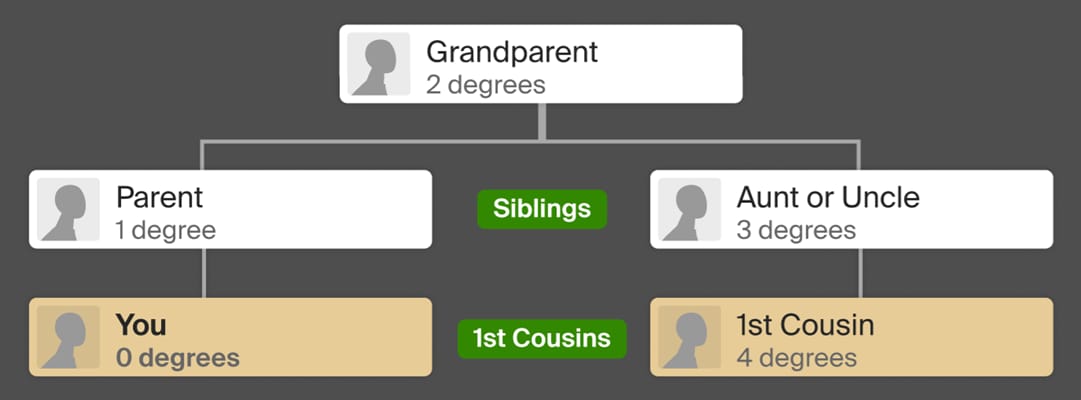
Degrees of separation show how many steps, or people, are between you and someone else in a family tree.
- 0 degrees: You or the starting person.
- 1 degree: Someone 1 step away, like a parent or child.
- 2 degrees: Someone 2 steps away, like a grandparent or grandchild.
- 3 degrees: Someone 3 steps away, like a great-grandparent, great-grandchild, Aunt, or Uncle.
For example, in the image below, you’ll see that your 1st cousin is four degrees of separation away from you because there are four people on the path between you and them in the family tree.
Knowing the number of degrees of separation can help you figure out where a DNA match might be connected in your family tree.
Cousins
The difference between a first, second, or third cousin is which set of grandparents you share:
- First cousins share grandparents.
- Second cousins share great-grandparents.
- Third cousins share great-great-grandparents.
What “Removed” means
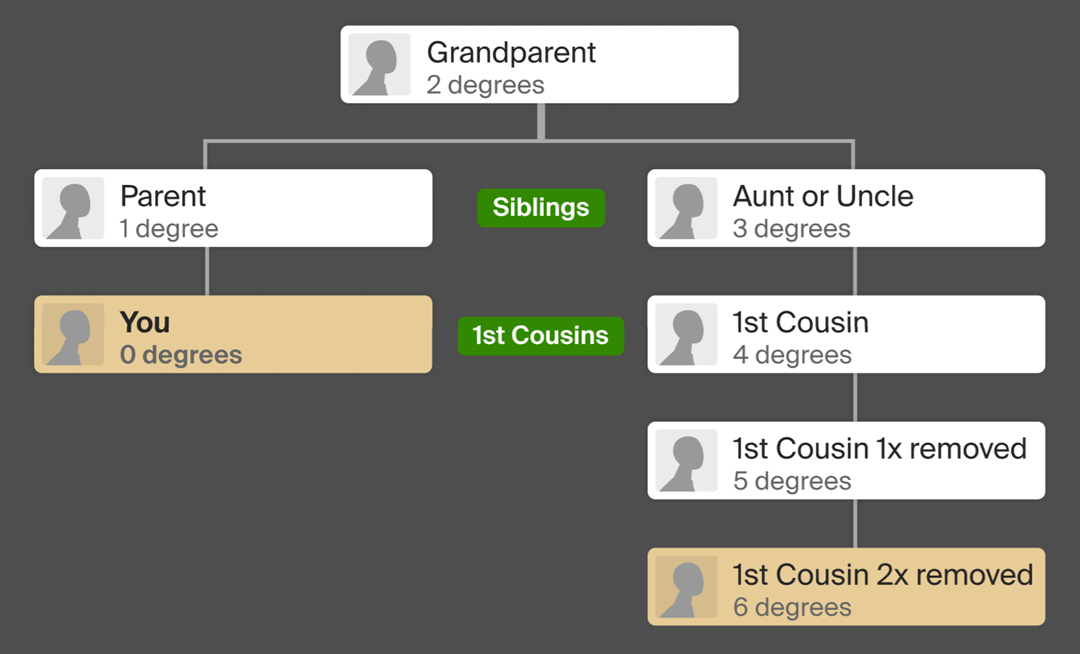
Removed refers to a difference in generations, or levels in the family tree, between you and your cousin. This difference in generation can go up or down in the tree.
- Once removed means 1 generation apart. For example:
- Your first cousin’s child is your first cousin once removed.
- Your parent’s first cousin is also your first cousin once removed.
- Twice removed means 2 generations apart, and so on.
For example, in the image below, you and a cousin share a grandparent, making them your first cousin. However, since they're two generations, or family tree levels, away from you, they're your first cousin twice removed.
Match categories
Here’s what the match categories mean, based on how much DNA you share.
Self/Twin
This category appears if you've taken the test more than once or your identical twin has also taken the test.
Parent/Child
Shared centimorgan range: More than 3,300 centimorgans
This category includes matches who are your parents or your children. If a parent is listed, it will say whether they’re your mother or father.
Full Sibling
Shared centimorgan range: 2,200–3,300 centimorgans
Degrees of separation: 2
This category usually includes brothers or sisters who share both biological parents with you. Sometimes in rare cases, a half-sibling who’s also your first cousin might also show up in this category.
Close Family – First Cousin
Shared centimorgan range: 1,300–2,200 centimorgans
Degrees of separation: 2–4
Possible relationships:
| Aunt or uncle | Great-grandparent or great-grandchild |
| Niece or nephew | Half sibling |
| Grandparent or grandchild | Double first cousin |
It’s rare for someone in this category to be a first cousin.
1st – 2nd Cousin
Shared centimorgan range: 340–1,300 centimorgans
Degrees of separation: 3–7
Possible relationships:
| First cousin | Half first cousin (sharing one grandparent) |
| Great-great-grandparent or great-great-grandchild | Second cousin |
| Great-aunt or -uncle or great-niece or -nephew | Great-great grandparent or great-great-grandchild |
| First cousin once removed | Great-great aunt or uncle or great-great-niece or nephew |
| Half aunt or uncle or half niece or nephew | |
2nd – 3rd Cousin
Shared centimorgan range: 90–340 centimorgans
Degrees of separation: 5–7
Possible relationships:
| Second cousin | Half first cousin once removed |
| First cousin twice removed | |
3rd – 4th Cousin
Shared centimorgan range: 65–90 centimorgans
Degrees of separation: 6–9
Possible relationships:
| Second cousin | Second cousin twice removed |
| Third cousin | First cousin twice removed |
| Half second cousin (one shared great-grandparent) | First cousin three times removed |
| Second cousin once removed | Third cousin once removed |
4th cousin and more distant
Shared centimorgan range: 6–65 centimorgans
Enough DNA is shared with closer relatives for us to predict relationships with a higher degree of accuracy. But for distant relatives, it’s harder to predict exact relationships based on DNA. That’s because:
- DNA is passed down randomly.
- We don’t always inherit DNA from ancestors in the expected amounts (like 25% from each grandparent or 12.5% from each great-grandparent).
- Relatives don’t inherit the same pieces of DNA from shared ancestors.
- Less DNA is shared with distant relatives, making it harder to predict how you’re related.
The amount of DNA shared between relatives at the 4th cousin level and beyond could represent many different types of distant relationships, but they’re unlikely to be closer than 6 degrees of separation from you. You’ll usually share about 20–85 centimorgans with a 4th cousin and 6–20 centimorgans with a 5th through 8th cousin.