Ever wonder which parts of your DNA connect you to a certain ancestral region or which parent passed it down to you? Our chromosome painter shows your ancestral regions “painted” on your chromosomes so you can see where in your DNA we found them and which parent they came from.
Here’s an example.
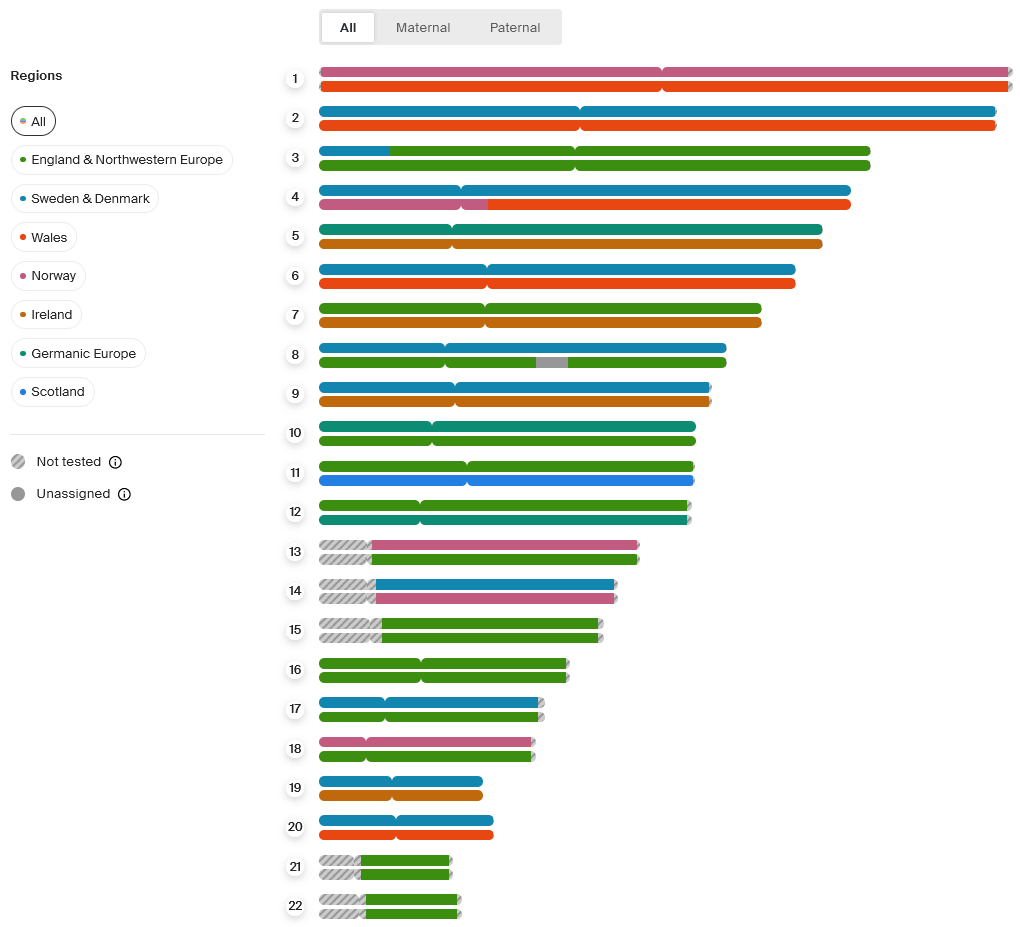
*This DNA feature requires an Ancestry® membership.
Exploring chromosome painter
To access the chromosome painter, you must have an Ancestry® family history membership.
To find the chromosome painter:
- From any Ancestry® page, click the DNA tab and select Origins.
- From your DNA results, click By parent.
- Choose View chromosome painter.
- Select Maternal or Paternal to see who passed down which regions by chromosome, or choose to see All
- (Optional) On the left, click a region to highlight it. Click it again to unhighlight it.
Understanding chromosomes and regions
DNA is stored in chromosomes
Every cell in your body has 6 feet of DNA stored in long strands called chromosomes. Most people have 23 pairs of chromosomes. One chromosome in each pair usually comes from your biological mother and the other from your biological father.
Of those 23 pairs of chromosomes, one pair is the sex chromosome that determines a person’s biological sex (chromosome painter doesn't show these). The other 22 chromosome pairs are called autosomes, and in the chromosome painter, we number them from longest to shortest.
Painting your regions on your chromosomes
To create your results, we divide your DNA into sections and compare each section to our reference panel. If a section looks like DNA from a specific region, we label it with that region. For example, if section 1 is similar to DNA from people in Vietnam, we label it "Vietnam." We do this for all 22 of your autosomal chromosomes. In our chromosome painter, the top chromosome in each pair is from Parent 1, and the bottom is from Parent 2. (Who is parent 1, and who is parent 2?)
Your results may change
Right now, we’re using the best science and data available, but DNA science is always improving. As science advances and we get more data, or release updates to ancestral regions, your chromosome painter results may change. And because the chromosome painter shows a close-up view of your chromosomes, these changes may be more noticeable than changes to your regions.
Frequently asked questions
Select a question below to view the answer. Select the question again to hide it.
Does the chromosome painter provide information about genetic diseases or other medical conditions?
No. The chromosome painter doesn’t show specific genes or whether your DNA segments match someone else’s DNA.
Why don’t I see 23 pairs of chromosomes?
There are two types of chromosomes: sex chromosomes and autosomes. Most people have 1 pair of sex chromosomes and 22 pairs of autosomes. Since autosomes hold the most information about your ancestral origin, we show only 22 pairs.
Why are chromosomes different lengths?
Chromosomes vary in length because they have a different number of genes. In general, the more genes, the longer the chromosome.
Why do some of my chromosomes only show one region?
Some chromosomes might only show one region if you have only a few regions. This can also happen if you inherited a large amount of one region from a recent ancestor. Chromosomes with multiple regions suggest the regions came from more distant ancestors. Over the generations, the DNA passed down from an ancestor gets broken into smaller blocks in their descendants.
As we improve our ancestral regions, your chromosome painter results will become more precise, too.
What do “not tested” and “unassigned” mean?
Some DNA segments, mainly at the edges and center of a chromosome, are harder to read. Since we don’t test these for regions, they’re labeled “not tested.” Untested segments are a tiny amount of your total DNA.
We also don’t show regions that you carry 0.5% or less of because our confidence in these assignments isn’t high enough to make them part of your results. DNA segments contributing to that 0.5% (or less) are labeled “unassigned.”
How is a chromosome painter different from a chromosome browser?
Our chromosome painter shows you where in your DNA we found the regions that make up your results. It can also reveal which biological parent you inherited certain regions from.
A chromosome browser helps people visualize the unique pieces of DNA two people share. They are mainly used to figure out relationships to other genetic relatives and to link DNA pieces to specific ancestors.
Ancestry does not have a chromosome browser at this time, but you can compare results with others to find shared regions, and if you compare your chromosome painter results, you may see where. Remember, shared regions don’t mean you have identical DNA–only that you have the same regions.
Who can see my chromosome painter results?
Only you, those you've shared your chromosome painter results with, and those invited to your DNA results can see your results.
I used to have free access to chromosome painter; why can’t I access it anymore?
Chromosome painter is now part of Ancestry family history memberships, one of which is required for access.