Many things can cause surprising AncestryDNA® results. Most have to do with the way DNA is passed down.
You may not have inherited certain DNA because:
- DNA inheritance is random, so you don't inherit 50% of your parents' ancestral regions
- at most, only half of someone’s DNA can be passed down
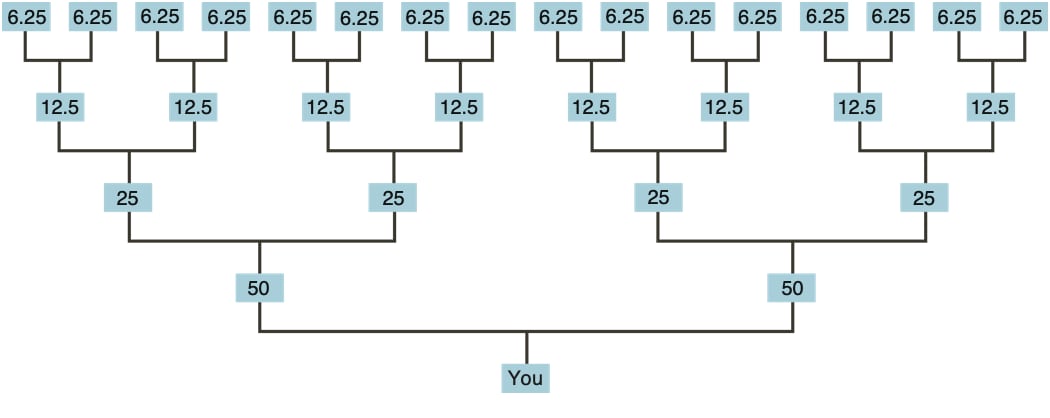
- beyond your parents, the amount of DNA you inherit from ancestors is not necessarily 25% from each grandparent, 12.5% from each great-grandparent, and so forth
- your DNA may also look more like DNA from regions near your ancestors' homelands than it does like DNA from their country.
DNA is passed down randomly
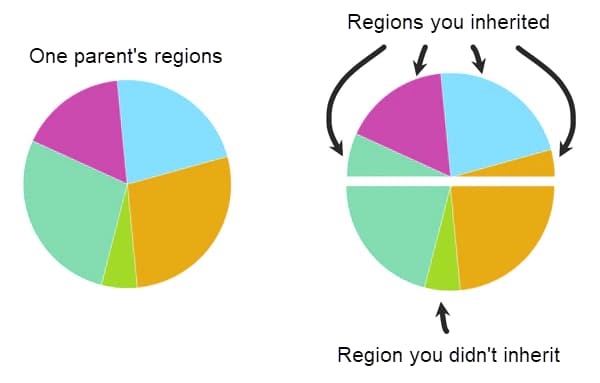
Each parent passed down half of their DNA to you. This means that there’s a half of their DNA that you didn’t inherit. Inheriting half of a parent’s DNA doesn’t mean inheriting half of each ancestral region. The DNA you inherit is random. One or both parents may have regions that they didn’t end up passing down to you–or they may have passed down only a small portion of a region they have.
If you have a great-great-grandparent who’s 100% Japanese, you might expect to have 1/16th (about 6%) Japanese. But that won’t necessarily be the case.
Most of your great-great-grandparent’s DNA was not passed down to you. This is because from your great-great grandparent’s generation down to you, you inherited DNA from 15 other people too. And since the DNA you receive is random, you don’t inherit a neat 50% of each region. There are some regions you may not inherit from them at all. This is why you can have ancestors who came from places you may not have ancestral regions from.
You can't inherit more than half of an ancestor's DNA
You receive 50% of your genes from each of your parents, but the percentages of DNA you received from ancestors at the grandparent level and further back are not necessarily neatly divided in two with each generation. The chart below shows probable (but not necessarily actual) percentages of genes you may have inherited from ancestors going back four generations.
At seven generations back, less than 1% of your DNA is likely to have come from any given ancestor.
Predicting inheritance is not an exact science
The percentages for regions in your ancestral origins are the most likely results we get after comparing your DNA to our reference panel. But they're not the only results. Other possibilities are nearly as likely. These other possible percentages make up a region's range.
When a range includes zero, it's possible that your ancestors didn’t live in that region or you didn’t inherit any DNA from ancestors who did.
Neighboring populations often share DNA
Over the last thousand years, some groups of people were isolated from other populations. Isolation gives populations a chance to develop a unique genetic signature.
When people from previously separated populations have children together, they share DNA in what we call admixture. As previously distinct populations mix together, they get harder to tell apart using genetics. If your family comes from a population with a history of admixture, your percentages for some regions may be different than you expect.
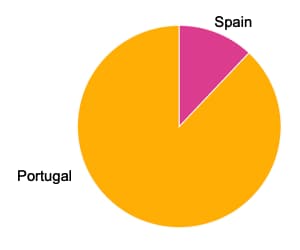
Groups of people who live near borders are often admixed. For example, many people with deep family roots in Portugal have about 12% DNA from Spain.
This is because Spain and Portugal are neighbors who have centuries of trade and migration between them. So even if both your parents were from Portugal, your results would likely show some DNA from Spain.
As we continue to improve our methods of analysis and increase the size of the reference panel we compare your DNA to, we should be able to provide more precise ancestral origins and better tell nearby regions apart. More sensitive tools may also mean we discover more instances of admixture between neighboring populations.
Inferring ancestral origins is an evolving science
Inferring people's ancestral origins from DNA is a challenge that scientists around the world are still working on. We provide the best results possible given our current data and knowledge, but we’re also working hard to improve the precision of your results.
Each time we update our data, it’s possible your ancestral origins will evolve along with our understanding of DNA science.
Siblings share only half of their DNA
If comparing your regions to your sibling's regions has caused confusion, there are a couple things to know.
Only half of a parent’s genes are passed on to each child, and siblings (except identical twins) don't inherit the exact same half. This means your siblings received some genes you didn’t, and vice versa. You and your siblings share about 50% of your DNA with each other.
If your parents’ genes were each a deck of 52 cards, you'd receive exactly 26 cards from each of them to form your own deck of 52. If you had a younger sibling, he or she would also receive 26 cards from each parent, and about half of that sibling's 52 cards would end up being the same cards you received. If a third sibling were born, that sibling would share about 26 cards with each of you too. Due to the random nature of inheritance, some siblings inherit more of some regions than others do, and some siblings may not inherit certain regions at all.
Learn more about unexpected results