Occasionally, we can’t read a specific marker, or position, in your DNA. This usually doesn’t matter for matching you with genetic relatives or determining your ancestral origins, but it can affect your trait results.
Luckily, biology can help us out. Like in a game where you guess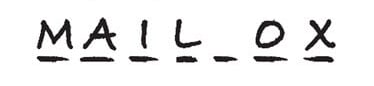 missing letters in a word by the letters you can already see, we can infer what a missing marker is based on the DNA around it. Scientists call this “imputation.”
How imputation works
Two facts about our DNA make imputation possible.
The first is that the hundreds of thousands of markers that we look at are lined up, one after the other, across long pieces of DNA called chromosomes. The second is that we tend to inherit stretches of DNA (rather than individual markers) from our parents.
What this means is that when we get a marker for, say, dry earwax, from one biological parent, we will also get lots of their markers that surround that earwax marker. In other words, we will get a stretch of their markers that include the dry earwax one.
It’s like the game example. Say you’re missing a single letter in a word: MAIL_OX. You can probably guess that the missing letter is B, and the word is “mailbox.” Imagine that the B is the marker for dry earwax. Even if we don’t see the B in our analysis, we can guess what it is from the markers around it.
The marker for wet earwax will have different letters around it. Imagine that it is the T in the word “fortune.” So, if for some reason we can’t read the earwax marker, we can look at the markers around it. If we see MAIL_OX, then we know this person has the dry earwax marker. And if we see FOR_UNE, then we will know the person has the wet earwax marker.
The DNA alphabet
Of course, DNA doesn’t have English words in it, but it does have a sort of alphabet made up of 4 letters—A, C, G, and T.
At the marker for earwax, rs17822931, dry earwax is a T and wet earwax is a C. If we can’t read the letter at rs17822931, we can deduce it from the surrounding markers.
Here is a real-world example of imputation. It only shows a few of the markers around the earwax markers, but it gives you an idea of how things work.
Here are some of the markers around the dry earwax marker (marked in red):
And here are some of the markers around the wet earwax marker (marked in red):
So, imagine we couldn’t read the earwax marker but saw this:
What do you think it is? That’s right—it’s the dry earwax marker.
How accurate is imputation?
While reliable, imputation still has a higher rate of error than simply reading the DNA. There are many reasons for this.
For example, sometimes the surrounding markers are too similar to easily tell apart. Or if the marker we can’t read is near the end of a chromosome, there may only be markers on one side of it. These are just a few of the ways imputation can sometimes be less reliable than directly reading the DNA. Issues like these make it particularly tricky to impute markers for three of our traits: red hair, freckling, and smelling asparagus in your urine.