Every person has two copies of a human genome, one inherited from each parent. Before a parent passes down a genome to a child, the parent's two copies of a genome crossover and recombine with each other in a random process. One of these copies is randomly chosen and passed to the child, as shown in Figure 1. (Be aware these illustrations simplify the process; the genome is billions of letters, and typically, there are dozens of crossovers.)
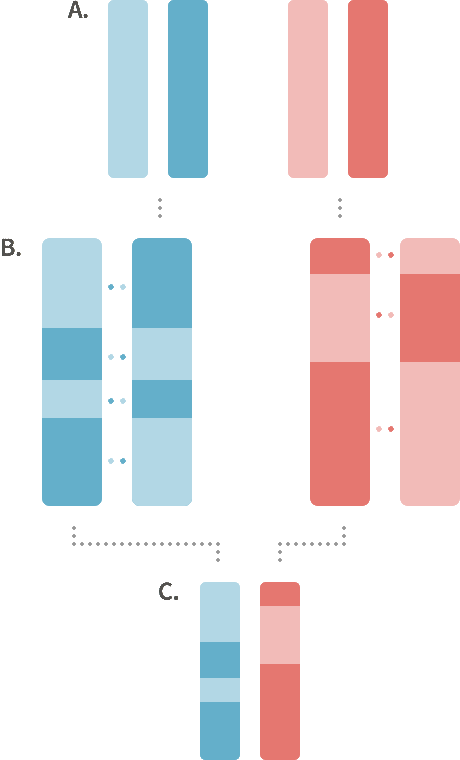
Figure 1. How DNA passes from a parent to a child. A, each parent has inherited a genome from their parents (the child's grandparents). B, each parent's genomes recombine before being passed on. C, the child inherits one recombined genome from each parent.
DNA inherited by siblings
The crossover that occurs when passing down DNA from parent to child is different every time, and the chromosome that is passed to a child is completely random. So, your brother or sister will have different DNA than you do.
For example, if a sister and brother take a DNA test, they will have long stretches of DNA letters in common. We call each of these segments a "DNA match" (see Figure 2). Sometimes, the siblings match on the blue and red sections of their chromosomes, and sometimes just on blue or red.
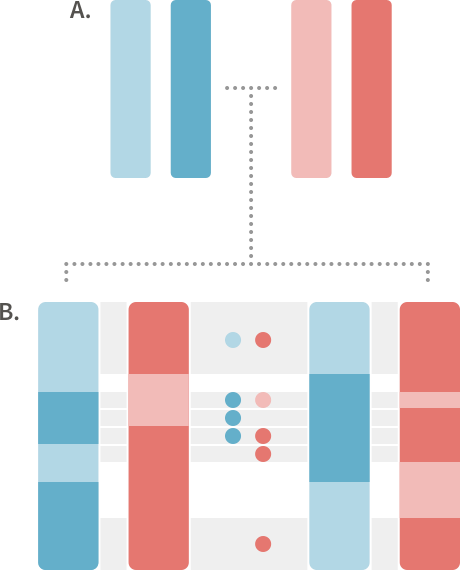
Figure 2. How DNA is passed down to siblings. A, each parent has inherited a genome from their parents (the child's grandparents). B, two siblings inherit different DNA; in many places, the DNA matches (the segments with the same color), but in cases where both chromosomes were inherited from a different grandparent, there is no DNA match.
DNA inherited by cousins
Let's look at how DNA would be passed down to first cousins. Figure 3 shows DNA matching between two first cousins. First cousins (who share a pair of grandparents and have no other common ancestors) can only match on one of their two chromosomes. It's important to notice that first cousins share less DNA than the pair of siblings. The amount of DNA that individuals share helps us to estimate their relationship.
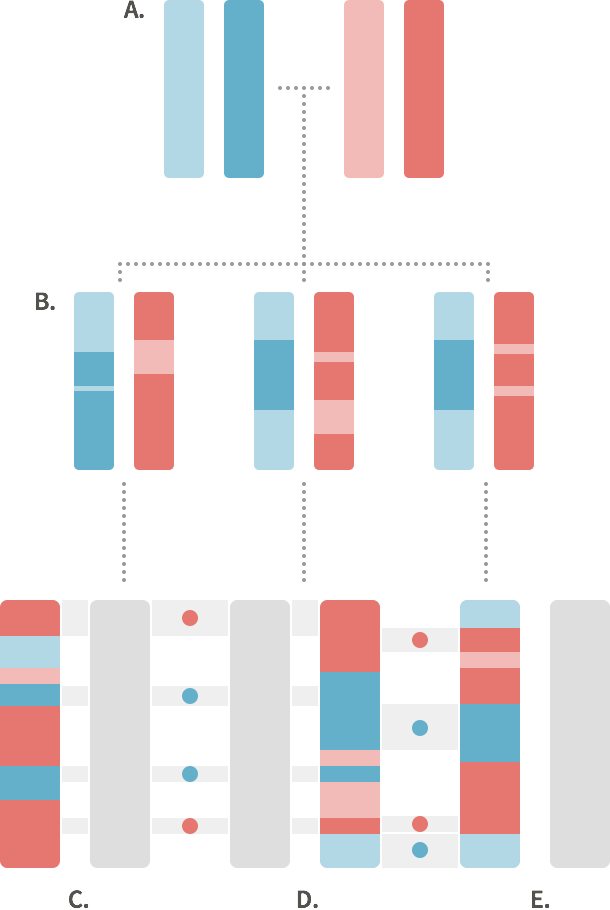
Figure 3. How DNA is passed down to first cousins. A, the common grandparents of cousins C, D, and E. B, the children of A and the parents of cousins C, D, and E. C, D, E, the grandparents' grandchildren; gray areas indicate DNA that has been inherited from ancestors other than couple A.
In Figure 4, you can see how DNA is passed down to distant cousins. All three cousins descended from two common ancestors. However, for these distant cousins to have a DNA match, it is not enough that they each inherit some DNA from a common ancestor; they have to inherit the same DNA. Cousins C and D are a DNA match, and so are cousins D and E. However, cousins C and E are not a DNA match—based solely on DNA, they would not appear to be related.
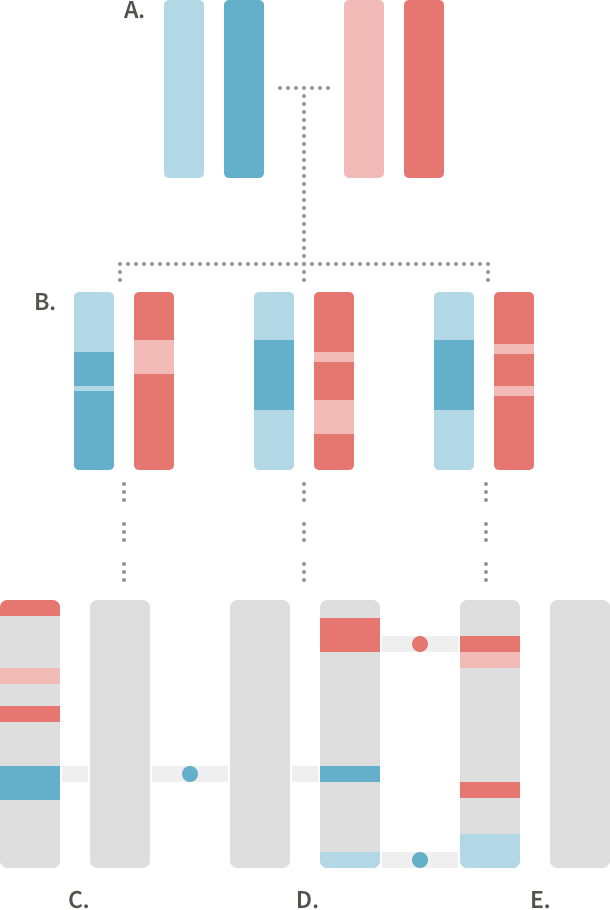
Figure 4. How DNA is passed down to cousins. A, the common ancestors of cousins C, D, and E. B, the ancestors' children. C, D, E, the ancestors' descendants; gray areas indicate DNA inherited from ancestors other than couple A.
As you can see, only a little DNA from a common ancestor is passed on after many generations. Since the recombination process exchanges entire sections of DNA, and the pieces of DNA you inherit are random, you may not have inherited any DNA from some of your ancestors. Table 1 shows how likely you will inherit DNA from a distant ancestor. The more generations that separate you and the ancestor, the more likely you did not inherit any of their DNA.
| Generations removed | Likelihood of inherited DNA |
|---|
| 1 | 100% |
| 2 | 100% |
| 3 | 100% |
| 4 | 100% |
| 5 | 100% |
| 6 | 99.99% |
| 7 | 99.5% |
| 8 | 96% |
| 9 | 84% |
| 10 | 64% |
Table 1. The likelihood that you inherit any DNA from either one of a pair of ancestors (like your great-grandparents).
For you to be a DNA match with someone, the same section of DNA would have to be passed down to both of you. Since DNA recombination is a random process, there may be no common DNA inherited by both of you. Table 2 shows how likely you are to have a DNA match with a cousin.
| Relationship | Likelihood of a DNA Match |
|---|
| Silbings | 100% |
| 1st Cousins | 100% |
| 2nd Cousins | 100% |
| 3rd Cousins | 98% |
| 4th Cousins | 71% |
| 5th Cousins | 32% |
| 6th Cousins | 11% |
| 7th Cousins | 3.2% |
Table 2. The likelihood that you and a cousin inherited the same DNA from either of your common ancestors.